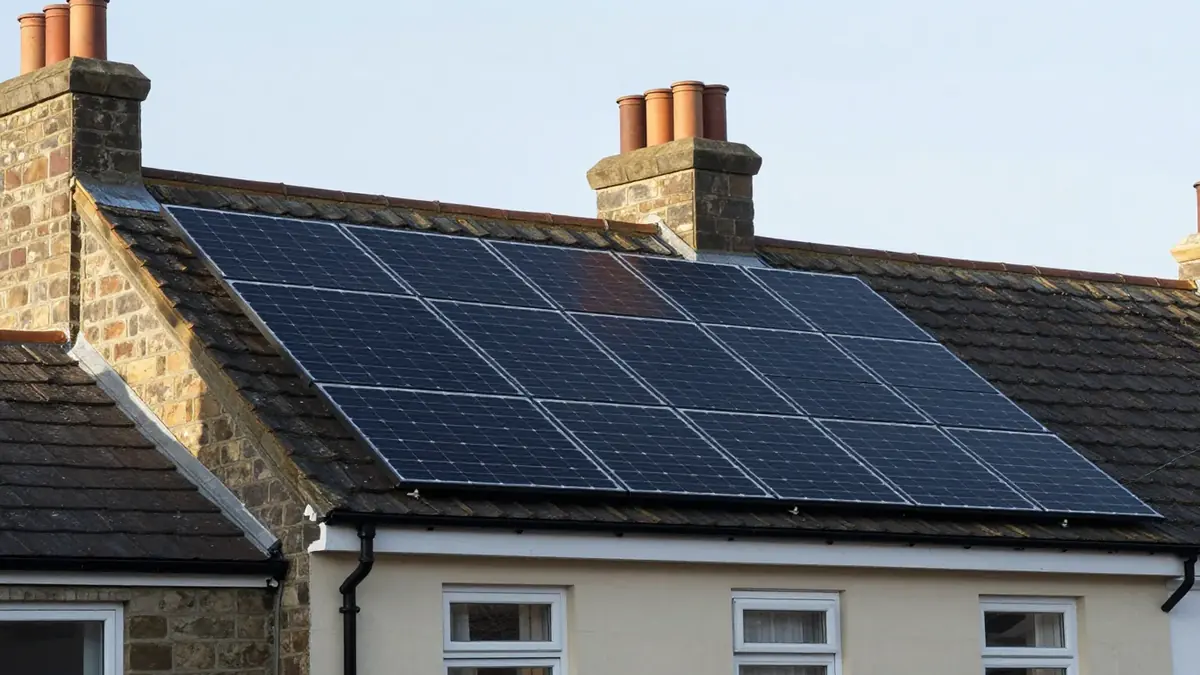
North-facing solar panels in the UK make roughly 45% less than south-facing ones at a common 35 degree pitch. They lose less on a shallow roof, where the gap shrinks to about 25%. Energy Saving Trust does not recommend them, so check every other option first.
What the sources say
Energy Saving Trust does not recommend putting panels on a north-facing roof. It gives no figure for the output, and we found no credible source that does. We therefore turned to PVGIS v5.3, the European Commission’s modelling tool.
PVGIS lets us model a north-facing roof directly. We assumed crystalline silicon panels and a 14% system loss. The figures below are kWh per kWp over a year.
PVGIS figures for three cities
Pitch matters a great deal for a north slope, because the steepness decides how far the panels turn from the sun. The steeper the roof, the more it turns away from the sun.
| City and pitch | South | North | North loses |
|---|---|---|---|
| London, 15 degrees | 951 | 709 | 25.4% |
| London, 35 degrees | 1,019 | 541 | 46.9% |
| Manchester, 15 degrees | 832 | 635 | 23.7% |
| Manchester, 35 degrees | 886 | 494 | 44.2% |
| Glasgow, 15 degrees | 796 | 605 | 24.0% |
| Glasgow, 35 degrees | 853 | 469 | 45.0% |
At 45 degrees in London the north figure drops to 459, which is 55.0% below south. On a steep pitched roof, then, north panels give you about half of what a south slope would. A shallow or flat roof does far better.
What this means for a 4kWp system
Take Manchester at 35 degrees, where our page on solar output in Manchester gives the south baseline. A 4kWp system facing south makes about 3,544 kWh a year, and facing north it makes about 1,976 kWh. You lose about 1,570 kWh.
For Sheffield and Newcastle we hold only south figures, at 947 and 948 kWh per kWp. Applying Manchester’s ratio of 494 to 886, about 56%, gives roughly 530 kWh per kWp on a north slope. That is a rough estimate, not a PVGIS result, and it means about 2,100 kWh from 4kWp. You can compare it with the baseline on our pages for solar output in Sheffield and solar output in Newcastle upon Tyne.
How our calculator treats north
Our calculator applies a factor of 0.65 for a mostly north roof. PVGIS gives 53% to 60% of south output at 30 to 35 degrees. That makes 0.65 generous for a steep slope, although it suits a shallow pitch better. Use the calculator as a first pass and treat a steep north slope with caution.
We keep the calculator simple on purpose, because it works from broad choices. It cannot see your exact pitch, chimney or neighbouring trees. For a precise answer on your own roof, you need a survey and an MCS estimate. Under MCS standard MIS 3002, the installer must use the table value for your postcode, pitch and orientation.
Try these options before you commit
First, check other slopes. Many houses have a roof face that points east or west. Energy Saving Trust says these tend to make 15% to 20% less than south, which is far better than north. Our post on east-west solar panels shows the gap in kWh.
Second, look at a flat roof, an extension, a garage or a ground mount. PVGIS gives 845 kWh per kWp in London for a flat layout, about 17% below the best south-facing figure. Tilting frames on a flat roof can do better still.
Third, think about your own use. If you work from home, a weaker array that runs most of the day may still cut your bills. In contrast, if you are out all day, a north slope adds exports at a low rate.
Shade and tilt make it worse
A north slope is often shaded more than a south one, because buildings, chimneys and trees sit between it and the sun. Shade can then cut the already low output sharply, so a shade check matters even more here. Our guide to solar panel shading and optimisers explains what installers can do about it.
Tilt is the other lever. Our post on the best tilt angle for solar panels in the UK shows why a flatter mounting helps a north slope. In general, though, you cannot always change the pitch of your roof.
Checking the economics
Costs do not fall just because the output does. DESNZ’s 2025/26 median installed cost is £1,595 per kW for systems up to 4kW. A 4kWp system therefore costs about £6,400 whichever way it faces, before any extra cost for scaffolding or a difficult roof.
Each kWh you use at home saves 26.32p at the October to December 2026 Ofgem price cap, at the time of writing. A north slope that makes 1,976 kWh gives a smaller saving for the same spend. Ask for a quote on both options and compare the cost per kWh made.
Cleaning is a smaller factor than direction, but it sometimes comes up. Our upcoming post on whether cleaning solar panels increases output looks at it. If you are weighing heat as well, see our upcoming guide on solar panels and heat pumps.
Next steps
Open the solar yield calculator and compare “Mostly north” with “East or west” for your region. Then bear in mind that PVGIS shows a bigger loss than the calculator at a steep pitch. When you want a real design, you can request quotes and we will pass your enquiry to MCS-certified installers. Our overview of solar panel installation explains how a survey works.