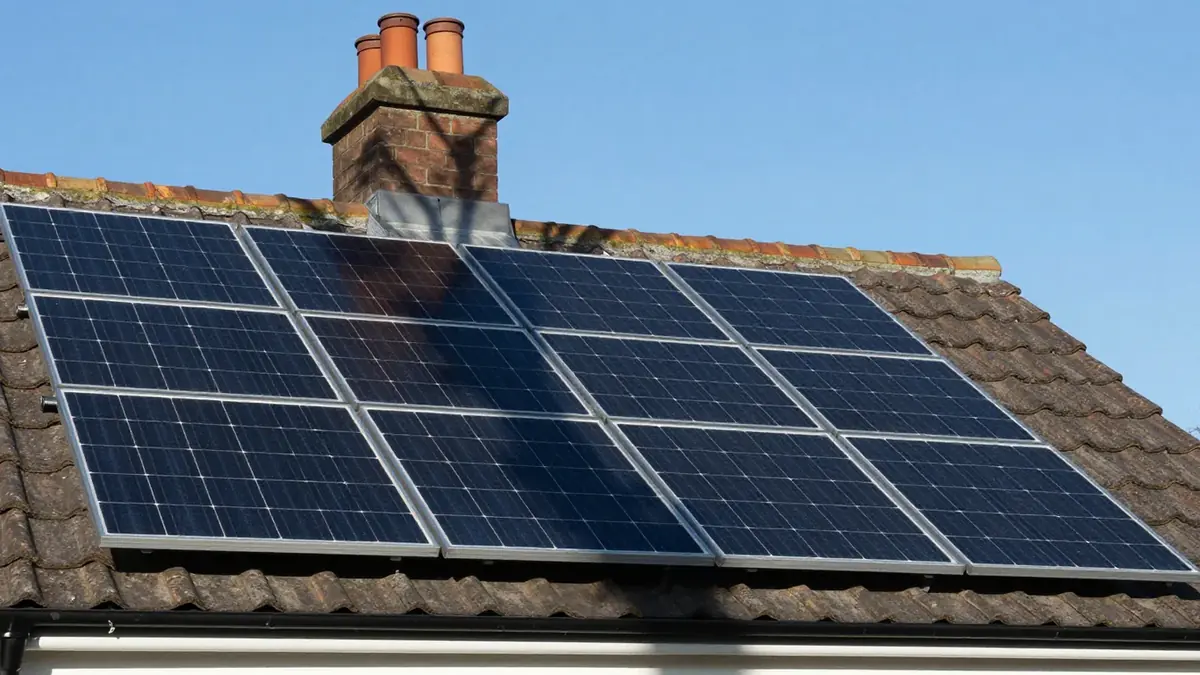
Shade is the quiet output thief. A chimney, tree or neighbouring wall can cut a solar system’s yield by more than a cheaper panel would. Installers score it with a shade factor between 0 and 1, so ask to see that number before you sign. Optimisers help in some cases, not all.
How installers score shade
Under the MCS standard MIS 3002, yearly output has three parts. Multiply the system size in kWp by a regional kWh per kWp figure. Then multiply by a shade factor.
The shade factor sits between 0 and 1. A value of 1.00 means a clear horizon with no near or far shading. The same standard calls the estimate guidance only, not a guarantee, so a rushed survey can still get shade wrong.
Near shade comes from things close to the array, such as a chimney, a dormer or a roof vent. Far shade comes from the horizon, such as a hill or a row of houses. A good survey records both, and it checks them at different times of year.
What shade does to a string of panels
Most home systems wire the panels in a string, so current flows through every panel in turn. If one panel sits in shade, it can limit the current for the whole string. Therefore a small patch of shade can cost more than its size suggests.
A shaded corner on a two-row array is not a minor detail. Two panels in shade can pull down a string of ten. The loss does not always match the shaded area.
Modern panels reduce this with bypass diodes, which let current skip a shaded section. Still, that section produces little, and the rest of the string may run below its best point.
A rough sense of scale
The Solar Yield calculator for UK solar yield offers four shading levels as stated assumptions. They are 1.00 for little or none, 0.90 for light, 0.75 for moderate and 0.55 for heavy. These are the site’s own modelling choices, not measured values. Use them to see the direction of the effect.
For example, PVGIS gives Bristol 1,023 kWh per kWp a year. A 4 kWp system there makes about 4,092 kWh with a clear roof. At a moderate factor of 0.75 that falls to roughly 3,069 kWh.
That is a loss of about a quarter, which is bigger than most panel upgrades close. The solar installation service page explains how an MCS survey tackles this. Meanwhile, any estimate of solar output in Bristol should state its shade factor. The guide to kWh per kWp shows how the base figure changes by place.
When optimisers and micro-inverters help
Optimisers sit on each panel and let it work at its own best point. Micro-inverters go further and convert power to AC at each panel. In both cases a shaded panel stops dragging down its neighbours.
They tend to earn their place in three situations. The first is a roof with moving shade, such as a chimney shadow crossing two panels each afternoon. The second is a roof split across several faces. The third is an array where one panel stays in shade and cannot move.
However, they add cost and one more part per panel that can fail. If your roof is clear for most of the day, the extra spend may never pay back. Ask the installer to show the shade assessment and to say in writing why they chose or skipped them.
Energy Saving Trust says the inverter needs replacing after around 12 years. Per-panel electronics add more items to that list. The guide to solar panel degradation covers what to expect from the panels themselves.
Ways to cut shade before you buy
Some shade you can remove. Energy Saving Trust advises keeping nearby trees trimmed. If a tree has legal protection, or your home sits in a conservation area, ask the council first. The rules on solar panel planning permission cover when you need to ask.
Moving the array is the other option. A shaded south roof can lose to a clear east or west roof. Energy Saving Trust puts east or west facing at around 15% to 20% less than due south. That is a known cost you can weigh against the shade.
A smaller array is sometimes the honest answer. Leaving the worst-shaded spot empty can give a better return per panel than filling every space. Put that question to your surveyor.
What a good shade check looks like
A good survey photographs the roof and the horizon from where the panels would sit. It notes the height and distance of trees and buildings. It then checks the sun’s path in different months, not only on the day of the visit.
Ask for the shade factor in writing, with the kWh estimate it produced. Compare both with what you see on site. In the north-east, low winter sun makes shadows long. A quote for solar panels in Newcastle upon Tyne should therefore show how the survey handled December.
Although PVGIS puts Cardiff at 1,042 kWh per kWp, shade still erodes that. Ask any firm quoting for solar installation in Cardiff to show the horizon check behind its figure.
Battery storage does not fix shade. It stores what the panels make, so it cannot add to a poor yield. The post on whether a solar battery is worth it shows how a lower yield changes the sums.
Shade also matters if you plan to add a heat pump. A smaller yield covers less of the load, since the panels have less to give. The post on solar panels and heat pumps explains how to size the two together.
Check your own roof
Start with the yield calculator. Try the shading options one after another and watch how the kWh figure moves. That shows what a shade claim could be worth before you speak to anyone.
When you are ready, the get quotes form passes your enquiry to MCS-certified installers. Solar Yield is an enquiry-referral service, not an installer. Ask each firm for its shade factor and kWh estimate, then compare them side by side.