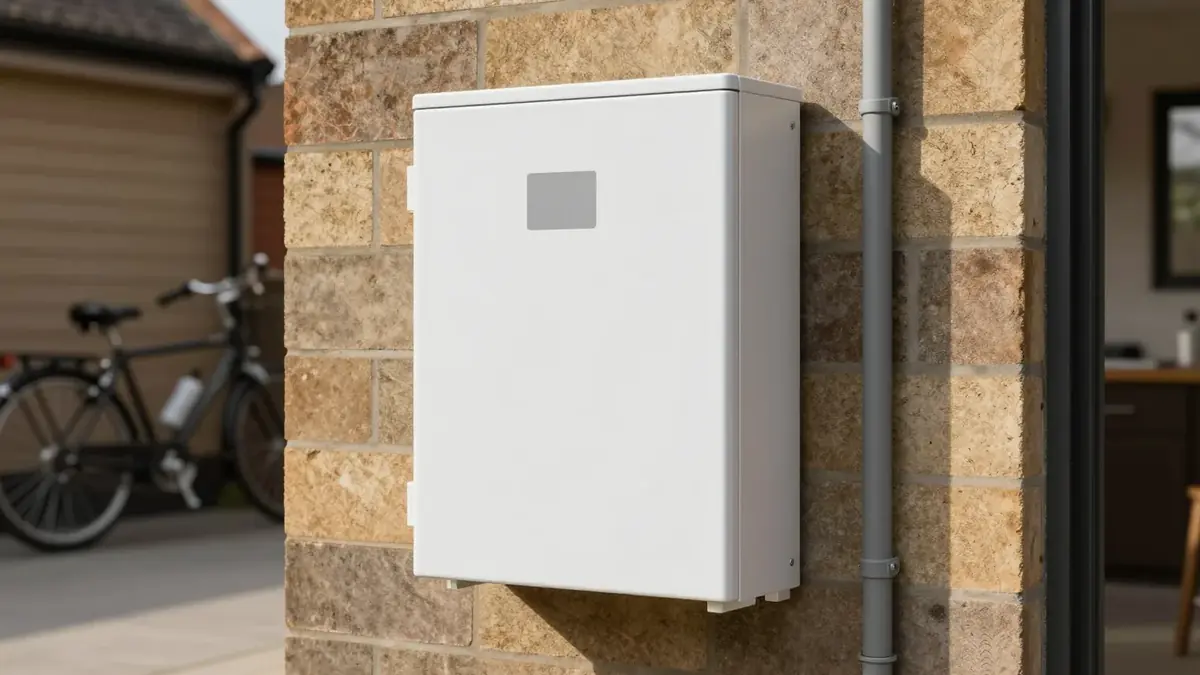
For most UK homes a solar battery is a long-term bet, not a quick saving. It earns the gap between the import price and the export rate on each kWh it shifts. That gap is about 14p at today’s figures. Against a typical cost of £5,000 to £8,000, payback often runs past a decade.
What a battery does
A solar battery stores surplus power from the middle of the day. You then use it in the evening instead of buying from the grid. Without a battery, that surplus goes out to the grid at your export rate.
Therefore the saving is not the full import price. It is the import price minus what you would have earned by exporting. That gap is small next to the cost of the battery, which is why the numbers need care.
What a battery costs
For a start, Energy Saving Trust says battery storage tends to cost around £5,000 to £8,000. DESNZ publishes median MCS battery costs for 2025/26. They run at about £1,300 per kWh for 1 to 6kWh batteries. Larger units cost less per kWh: £890 for 6 to 11kWh and £630 for 11 to 30kWh.
Those figures include installation. A typical 5kWh battery therefore lands near £6,000 to £6,500, and a 10kWh unit near £9,000. Which? agrees that batteries cost less when bought with the panels than added later.
However, VAT helps for now. Installing solar panels and batteries in a home is zero-rated until 31 March 2027, and the 5% rate returns after that. Check for any extension before you plan around 2027.
The plain arithmetic
Currently, the Ofgem price cap electricity unit rate is 26.32p per kWh for October to December 2026. Energy Saving Trust puts a typical export payment near 12p per kWh. The gap is 14.32p for each kWh the battery moves from export to self-use.
For example, take a generous case. A 5kWh battery that fills and empties once a day for a full year shifts 1,825 kWh. At 14.32p that is about £261 a year. At a cost of £6,000, payback takes around 23 years.
A realistic case is lower, because a battery does not fill every day. If you shift 1,000 kWh a year, the saving is £143.20 and payback stretches past 40 years. These sums ignore losses in the battery and any rate changes. They also run past the 12 years after which Energy Saving Trust says an inverter needs replacing.
Why winter limits the gain
A battery stores power but does not make it. In winter the panels make little, so there is rarely a surplus to store.
PVGIS data shows how big the swing is, because output falls sharply after summer. A 4kWp system in Manchester makes about 3,544 kWh a year, but December gives only about 113 kWh. That is under 4 kWh a day across the whole month. In June the same system makes about 443 kWh.
Our page on solar output in Manchester lists the monthly figures. The pattern is the same elsewhere, so most battery use happens between April and September.
Where a battery can make sense
Some homes tip the sums the other way. A household that exports a lot and uses most power after dark gains more. So does one with an electric car or heat pump, because a larger evening load gives the battery more to do.
Output also matters, since a sunnier site fills the battery more often. PVGIS gives about 1,032 kWh per kWp for Norwich and 1,041 for Cambridge, against 886 for Manchester. A 4kWp system would make about 4,128 kWh in Norwich and 4,164 kWh in Cambridge.
See the pages on solar output in Norwich and solar output in Cambridge for the monthly detail. All figures come from PVGIS v5.3.
Still, a higher yield rarely changes the verdict on its own. It shortens payback a little. The bigger levers are your daytime use and your export rate. We cover the second in our Smart Export Guarantee explainer.
Panels first, battery later
Many people start with panels and add a battery later. However, the panels carry most of the saving, and you can size a solar panel installation without a battery in mind.
Our look at the solar panel payback period shows how fast panels alone repay their cost. Compare that with the battery sums above before you add storage.
A good installer will leave room for a battery later, for example by choosing a compatible inverter. If you do want one now, read about solar battery storage and what an installer should quote. Roof direction changes the surplus too, as the post on east-west solar panels shows.
Check the quote
Battery quotes vary widely, so compare like with like. Ask for usable capacity, not just the headline size. Ask what the warranty covers and what happens to the inverter. Our guide on how to check a solar quote lists the questions worth asking.
Tilt also affects how much surplus you make in spring and autumn. PVGIS puts the optimal tilt at 41 degrees for both Norwich and Cambridge. The post on the best tilt angle for UK panels explains why. A roof facing away from the sun is a separate problem, and our post on north-facing solar panels covers it.
Next steps
Solar Yield is an independent estimator. It passes enquiries to MCS-certified installers, and it does not install anything itself. Use the solar yield calculator to estimate your yearly output, then compare how much of it you would use. When you want real prices for panels with or without a battery, request quotes and ask each installer to show its working.