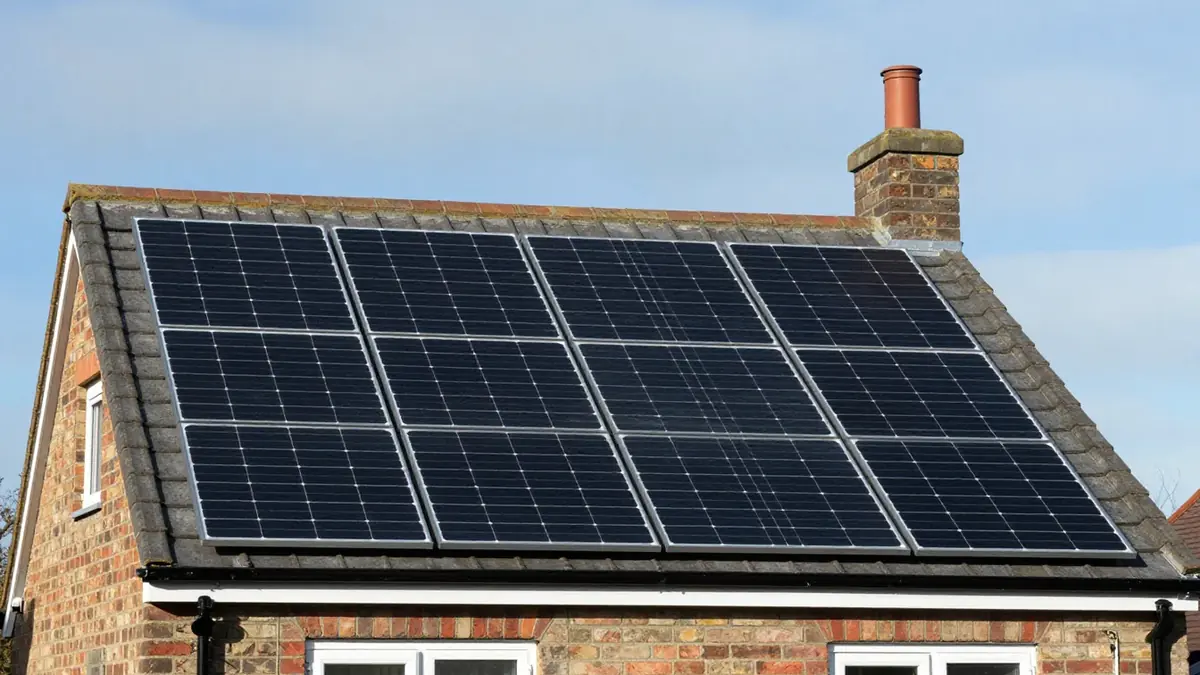
Most UK homes fit between 2kWp and 6kWp of solar panels, with around 4kWp to 4.5kWp as a common middle. The right size depends on your yearly electricity use, your usable roof area and your budget. Because output per kWp varies by place, your location then sets the kWh.
Start with how much electricity you use
Your annual use is the first number to find. Ofgem’s typical domestic consumption values for a standard meter are 1,600 kWh (low), 2,500 kWh (medium) and 3,800 kWh (high). Your supplier bill or smart meter app will show your real figure.
However, heat pumps and electric cars change this a great deal. If you plan either, size for the use you expect, not today’s. Our upcoming guide on solar panels and heat pumps covers the heat pump case.
Turn use into a system size
Next, divide your annual use by the kWh each kWp makes where you live. We take that figure from PVGIS v5.3, assuming a south-facing roof at a 35 degree tilt. Our pages on solar output in Birmingham, Leeds solar figures and solar output in London show the local detail.
| Annual use | Birmingham (968 kWh/kWp) | Leeds (947 kWh/kWp) |
|---|---|---|
| 1,600 kWh | about 1.7 kWp | about 1.7 kWp |
| 2,500 kWh | about 2.6 kWp | about 2.6 kWp |
| 3,800 kWh | about 3.9 kWp | about 4.0 kWp |
This is the size that would match a year’s use on paper. It does not mean you use every kWh yourself. Much of the output arrives when the house is empty, so a system sized this way still exports a share.
Why sizing to your annual total can mislead
Solar makes most of its power in summer and at midday. Your own use is highest in the morning and evening, and in winter. As a result, a bigger system raises your exports faster than it raises your savings.
Savings and export, in contrast, pay very differently. Between October and December 2026, the Ofgem price cap sets the electricity unit rate at 26.32p per kWh. Energy Saving Trust says you typically get around 12p for each exported unit. Our post on the Smart Export Guarantee explains how that works.
Since rates change often, treat both figures as correct at the time of writing. The gap between them is the reason to think about daytime use first. A household at home all day can justify a bigger array than one out at work.
Check your roof space
Although the sums matter, a system also needs somewhere to go. Energy Saving Trust describes a typical 4.5kWp system as around 12 panels covering 20 to 30 square metres of roof. That implies panels of roughly 375 watts each, though your installer’s model may differ.
A south-facing slope gives the best return. If your best slope faces east or west, expect 15% to 20% less, according to Energy Saving Trust.
Shade matters too, and a chimney or tree can reduce the useful area. Dormer windows, roof lights and vents also take space, so a survey often finds less room than a rough measure suggests. Our post on solar panel output for a 4kW system shows what a mid-sized array makes in different cities.
What size costs
For costs, DESNZ publishes median installed figures from MCS data. The 2025/26 figures show £1,595 per kW for systems up to 4kW and £1,546 per kW for 4 to 10kW. Those include equipment, installation, connection and any VAT due.
As a result, at those medians a 2.6kWp system costs about £4,100 and a 4kWp system about £6,400. A 6kWp system comes to about £9,300. These are derived estimates, so real quotes will differ. Between those sizes, the cost per kW barely changes, so the bigger question is how much of the output you will use.
Meanwhile, installing solar panels in a home is currently zero-rated for VAT. HMRC guidance says this applies until 31 March 2027, after which a 5% rate returns. Check for any extension before you decide.
Grid limits and the size ceiling
There is one technical limit worth knowing. Under ENA rule G98, a type-tested system up to 16A per phase connects first. That is about 3.68kW on single phase. Your installer then tells the network operator within 28 days.
Above that limit, G99 applies and the installer must get approval first. Ask your installer early which route your design needs.
However, the operator may then limit export or ask for reinforcement. Some installers cap export to stay under G98 instead. Either way, your installer should explain which route applies to your roof.
Winter, cleaning and direction
Size also affects how your system behaves through the year, because winter is weak. In winter output is a small fraction of summer output, as our post on solar panel output in winter shows. A bigger array lifts that floor a little but not by much.
Furthermore, two smaller questions come up. One is whether a north-facing roof can ever work, which our upcoming post on north-facing solar panels covers. The other is whether cleaning helps, which we answer in does cleaning solar panels increase output.
Next steps
Open the solar yield calculator and move the capacity slider to see how output changes by size. Then compare that with your own bills. When you are ready for real designs, you can request quotes and we will pass your enquiry to MCS-certified installers. Our overview of solar panel installation explains what a survey and a quote should include.