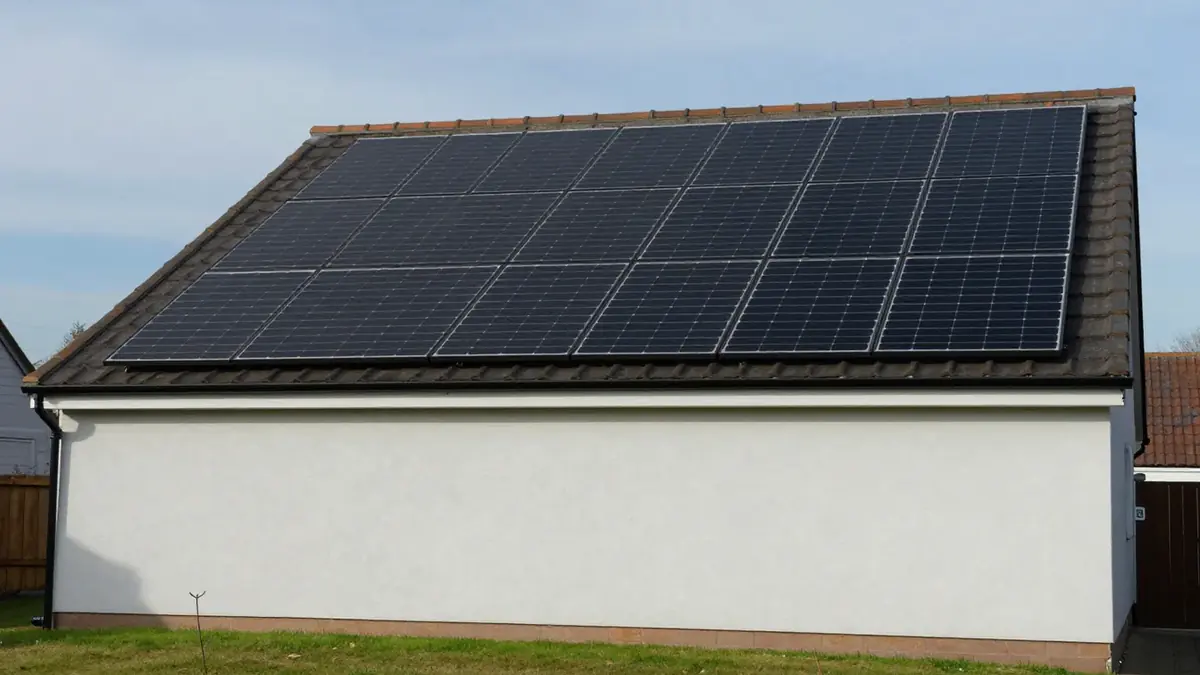
The best tilt for solar panels in the UK is about 39 to 43 degrees on a south facing roof, says PVGIS. Anything from 30 to 45 degrees comes within about 1% of that peak. Many pitched roofs fall near that band, so you rarely need to change anything.
What the PVGIS figures show
PVGIS v5.3 is the European Commission’s modelling tool. For this post we ran it for three cities with south facing panels, crystalline silicon and a 14% system loss. The table shows annual kWh per kWp at each tilt.
| Tilt | London | Manchester | Glasgow |
|---|---|---|---|
| 0 degrees (flat) | 845 | 745 | 710 |
| 15 degrees | 951 | 832 | 796 |
| 30 degrees | 1,010 | 880 | 845 |
| 35 degrees | 1,019 | 886 | 853 |
| 45 degrees | 1,019 | 885 | 853 |
The curve is flat at the top, so small changes in angle matter little. In London, 35 and 45 degrees give the same 1,019 kWh per kWp. In Manchester, 35 degrees gives 886 and 45 degrees gives 885. Across the whole 30 to 45 degree band, output stays within 1% of the peak.
Where tilt starts to cost you
However, the loss grows as the angle falls. At 15 degrees, London makes 951 kWh per kWp, which is 6.7% below the 35 degree figure. Manchester makes 832, or 6.1% below.
Panels laid flat lose more. London drops to 845, about 17% below, and Manchester to 745, about 16% below. That is a real gap. Still, it is close to the 15% to 20% that Energy Saving Trust quotes for an east or west roof.
For a 4kWp system, those percentages turn into kWh. In London, 35 degrees gives about 4,076 kWh a year. Flat panels give about 3,380 kWh, a difference of nearly 700 kWh. Our post on how much a 4kW system generates puts that into context.
Optimal tilt by city
PVGIS also reports the single best angle for each location. It sits a little higher in the north, because the sun is lower. The figures for three more cities are close to each other.
| City | Optimal tilt | kWh per kWp at 35 degrees | kWh per kWp at optimal tilt |
|---|---|---|---|
| Oxford | 40 degrees | 1,018 | 1,021 |
| Liverpool | 40 degrees | 965 | 968 |
| York | 42 degrees | 969 | 973 |
However, the gain from using the exact optimum is 3 to 4 kWh per kWp a year. That is about 0.3% to 0.4%, which a 4kWp system would see as roughly 12 to 16 kWh. No installer will redesign your roof for that. Our pages on solar output in Oxford, solar output in York and solar output in Liverpool add monthly detail.
In kWh, a 4kWp system at the optimal tilt makes about 4,084 kWh in Oxford. York gives about 3,892 kWh and Liverpool about 3,872 kWh. Meanwhile, the whole solar panel installation service page explains how an installer turns these figures into a quote.
What this means for your roof
Installers usually mount panels flush to the roof, so the pitch you have sets the angle. If your pitch falls between 30 and 45 degrees, you are already close to ideal. A very steep roof, or a very shallow one, is where the figures start to matter.
On a flat roof, installers use frames to lift the panels. A frame at 15 degrees keeps most of the output, since PVGIS shows London at 951 against 1,019. Because a steeper frame needs wider row spacing, a low angle can fit more panels on the same roof.
Tilt also changes when you get your power. PVGIS puts the best angle higher in the north, because the sun sits lower there. Our look at solar panel output in winter shows how small the winter figures are.
Tilt and shading
Because a steep angle throws longer shadows onto rows behind, shading matters on flat roofs. On a pitched roof, shading comes from chimneys, dormers, trees and neighbouring buildings. Shade often costs more than a few degrees of tilt. Read our guide to solar panel shading and optimisers before you worry about angle.
Tilt and planning rules
In England, roof panels are normally permitted development if they project no more than 200mm from the roof slope. They must not rise above the highest part of the roof. On a flat roof, panels can stand up to 600mm above the highest part.
That limit shapes how tall a tilt frame can be. Scotland and Wales have their own rules. We cover all four nations in our post on solar panels and planning permission.
Self-cleaning and tilt
Steeper panels shed dirt more easily, since rain washes a tilted surface better than a flat one. Nevertheless, there is no authoritative UK figure for soiling loss, so we do not put a number on it. If you are wondering about cleaning, our post asks whether cleaning solar panels increases output.
Check the quote
Since MCS rules apply, every MCS installer must give you an output estimate that accounts for your roof pitch and direction. Compare that with your own PVGIS-based figure. If an installer’s number is much higher, ask for the working. Our guide on how to check a solar quote lists the questions.
Next steps
Solar Yield is an independent estimator. It passes enquiries to MCS-certified installers, and it does not install anything itself. Use the solar yield calculator to test your roof pitch and direction. When you want an installer’s own estimate to compare, request quotes and ask for the MIS 3002 output figure.