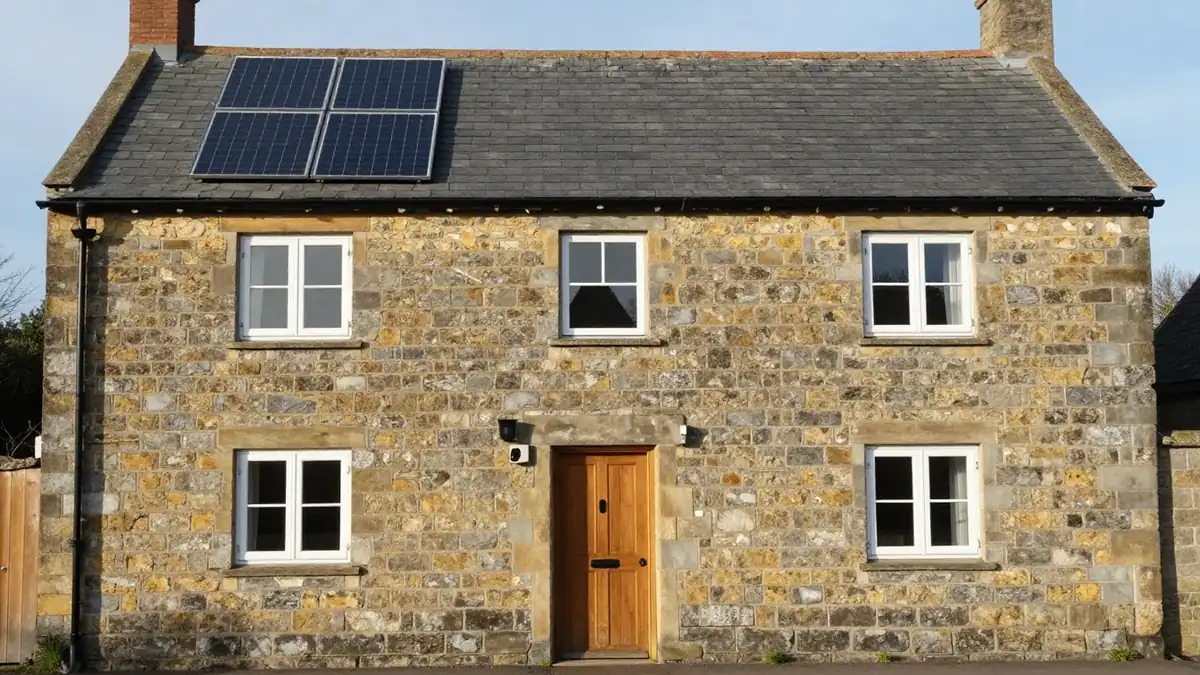
Most home solar panels in the UK need no planning permission, because they count as permitted development. The limits differ by nation. In England, roof panels should stay within 200mm of the roof slope, while in Scotland the figure is 1m. Listed buildings and some conservation areas are the main exceptions.
England: the 200mm rule
The Planning Portal sets out the main test for a house roof. Panels must not project more than 200mm from the roof slope. They also must not rise above the highest part of the roof, not counting the chimney. On a flat roof, they can stand up to 600mm above the highest part.
These limits come from Part 14 of the permitted development order. The government updated the right on 27 August 2026. A transitional period to 27 August 2027 lets you follow either the old or the new rules. The 200mm roof limit and the highest-part limit have not changed.
The update also set new limits for panels on walls and balconies. Panels may stand up to 0.2m beyond the wall plane next to a highway, and up to 0.4m elsewhere. Ask your installer which version applies if your plans involve a wall.
Listed buildings and conservation areas
Permitted development does not apply to a listed building, its curtilage or a scheduled monument. Panels there need planning permission and listed building consent. Therefore, check your property’s status before you request any quotes.
Conservation areas and World Heritage Sites work differently. In England, you cannot fit panels to a wall, balcony or roof enclosure that fronts a highway. A roof slope that does not front a highway can still qualify.
However, the council can go further. An Article 4 direction removes permitted development rights locally, and you will only find out by asking. Contact your local planning authority first and confirm in writing. Homeowners comparing solar output in Nottingham with other cities should do the same with Nottingham City Council.
Scotland: the 1m rule
Scotland has its own rules. Under Class 6HA of Circular 1/2024, solar panels on a dwelling count as permitted development. No part may protrude more than 1m from the wall, roof plane, ridge or chimney. That is a more generous limit than England’s 200mm.
Scotland also excludes listed buildings, their curtilage and World Heritage Sites. In a conservation area, panels go only on a rear elevation or a side one that does not front a road. So a rear-facing slope may work where a front one does not.
If you live in Edinburgh, which has a large historic core, this matters. Our page on solar output in Edinburgh shows about 903 kWh per kWp a year from PVGIS. Glasgow is lower at 853 kWh, as the page on solar output in Glasgow explains. A restricted roof can cost you output, so weigh the planning limits against the yield.
Wales and Northern Ireland
Wales follows a similar pattern to England. The Welsh Government says roof solar on a single house is usually permitted development. Panels should project no more than 200mm and must not go above the ridgeline. Listed buildings need planning permission and listed building consent.
In conservation areas and World Heritage Sites in Wales, panels on principal or side walls visible from the highway need permission. On flat roofs, panels must sit 1m from the edge and no more than 1m above the roof plane. Local Article 4 directions can remove rights as they can in England.
Northern Ireland is less specific. nidirect says you may need planning permission, especially in conservation areas or on listed buildings. We could not confirm exact limits, so check with your council planning office first.
Grid connection is a separate step
Planning rules cover the building. However, your network operator needs to know about the system as well. This is a different process with different rules.
Under Engineering Recommendation G98, a fully type-tested system up to 16A per phase can connect first. That is about 3.68 kW on a single-phase supply. The installer then notifies the operator within 28 days of commissioning.
Larger systems fall under G99, and the installer must get approval before installing. The operator may limit export or ask for network reinforcement. In Northern Ireland the equivalent rule is G98/NI, with 30 days to notify NIE Networks.
An MCS-certified installer normally handles this paperwork for you. Our guide to how to check a solar quote lists what to ask for. Once the system is live, you will want to read its data. Our upcoming guide on reading your solar inverter app covers that.
How planning links to output and payback
A compliant roof is only half the story. Since you also want a system that earns its cost back. Our guide on how much electricity a 4kW system generates sets realistic expectations, and the payback guide turns them into a timeline.
Planning limits can push you towards a second-best roof. For example, if the south slope fronts a road in a conservation area, an east-west layout might be your option. Our guide to east-west solar panels explains the trade-off. Energy Saving Trust says east or west facing systems tend to get 15% to 20% less than south facing ones.
Remember that panels lose a little output each year too. Our note on solar panel degradation shows a median loss of 0.5% a year.
Next steps
Start by checking your property’s status with your local council. Then run your roof through our solar yield calculator to see what a realistic system might generate. When you are ready, you can request quotes from MCS-certified installers.
Solar Yield passes on your enquiry, but it does not install anything or give planning advice. Therefore, confirm the rules with your council. Our overview of solar panel installation explains what happens after you enquire.