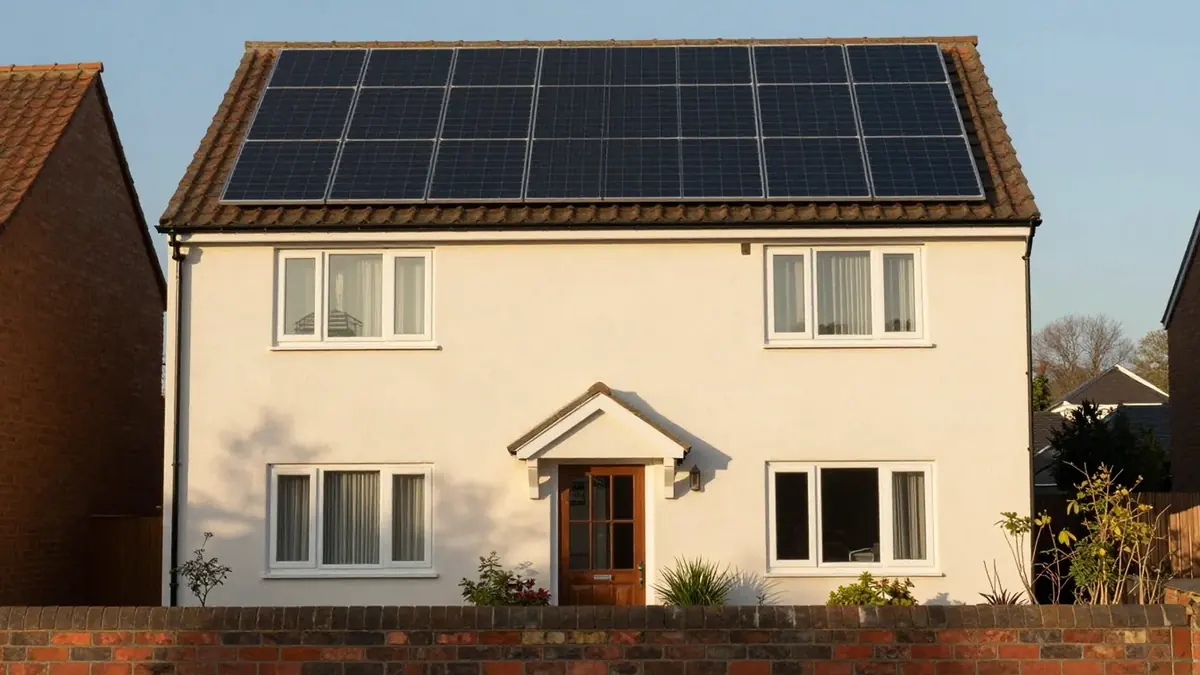
Payback is the installed cost divided by your yearly saving. For a 4 kWp system costing about £6,400, our examples give roughly 8 years in Southampton and 9 in Aberdeen. Belfast comes to 13, with no export income. These examples assume you use half the output, so your own figure will differ.
The basic sum
The formula has three parts. Take the installed cost, work out how much electricity the panels generate, then value each unit. Divide the cost by the yearly value and you have a payback in years.
Each part needs an honest input, because small errors compound. Cost comes from quotes and government data. Output comes from PVGIS or your installer’s MCS estimate. Value depends on whether you use the power or export it.
Treat the result as a range, not a promise, since prices, tariffs and your own habits all move. Our solar yield calculator lets you change each input and watch the answer shift.
Step 1: the cost
The Department for Energy Security and Net Zero publishes median installed costs from MCS data. For 2025/26 the figure is £1,595 per kW for systems up to 4 kW. That covers equipment, installation and connection, but not batteries.
At that median a 4 kWp system costs about £6,400. Energy Saving Trust gives a higher figure of around £7,600 for a typical 4.5 kWp system. However, use your own quotes where you have them. Our guide to checking a solar quote shows what to compare.
Step 2: the output
Output varies a lot across the UK. We use PVGIS from the European Commission for a south-facing roof at a 35 degree tilt. The PVGIS tool gives about 1,064 kWh per kWp a year in Southampton, 893 in Aberdeen and 919 in Belfast.
For a 4 kWp system that means about 4,256 kWh in Southampton, 3,572 kWh in Aberdeen and 3,676 kWh in Belfast. Each city page shows the monthly pattern. See solar output in Southampton, solar output in Aberdeen and solar output in Belfast.
Those totals are not evenly spread because most energy arrives in spring and summer. A payback built on annual output hides a slow winter. Our guide to solar panel output in winter shows the monthly shape. For a broader view of what a typical system produces, read how much electricity a 4kW system generates.
Step 3: the value of each unit
A unit you use at home saves what you would have paid. From October to December 2026, Ofgem’s price cap sets an electricity unit rate of 26.32p per kWh. That is the Great Britain average. That figure excludes VAT, since VAT on electricity is 0% until 31 March 2027.
However, your own tariff may be higher or lower.
A unit you export earns the export rate instead. Energy Saving Trust says you typically get around 12p for every unit through the Smart Export Guarantee. Our guide to the Smart Export Guarantee lists named tariffs and who can claim.
The scheme covers England, Scotland and Wales only, while in Northern Ireland export tariffs depend on your supplier. The Belfast example below therefore counts no export income.
Three worked examples
These examples use one assumption of our own: you use half of what the panels generate and export the rest. That is a guess, not a fact. For example, a home with someone in during the day could use more.
In Southampton, 4,256 kWh a year splits into 2,128 kWh used and 2,128 kWh exported. The used units save about £560 at 26.32p. The exported units earn about £255 at 12p. That is about £815 a year, so a £6,400 system pays back in around 7.8 years.
In Aberdeen, 3,572 kWh splits into 1,786 kWh used and 1,786 kWh exported. The saving is about £470 and the export income about £214, a total near £684. Payback comes to around 9.4 years.
In Belfast, 3,676 kWh splits the same way, but we count only the saving. The used 1,838 kWh save about £484 a year. Without export income, payback stretches to around 13 years. Northern Ireland has no financial support for domestic generation according to nidirect, though a supplier tariff could change the picture.
What the sum leaves out
Several things push your figure either way. For instance, panels lose output slowly, and a NREL review found a median loss of 0.5% a year. Our note on solar panel degradation explains what that means over 25 years. Shading can cut output too, and our guide to shading and optimisers covers the fixes.
Energy Saving Trust says an inverter may need replacing after around 12 years. Therefore, a replacement cost belongs in a long payback sum. Furthermore, the price cap changes every quarter, so next year’s saving per unit will differ.
VAT matters as well, although the date is close. Installed solar and batteries carry 0% VAT until 31 March 2027, and the 5% rate returns afterwards under current rules. Check for an extension if your project falls close to that date.
Where batteries fit
A battery raises the share of solar power you use, because it stores the midday surplus for the evening. It also adds cost. DESNZ data shows median retrofit battery costs of about £890 per kWh for batteries of 6 to 11 kWh.
Work out a battery separately, since it has its own cost. Estimate the extra units it lets you use, value them at your import rate, and compare that with its cost. Our page on solar battery storage explains how the pieces fit.
Scottish households
Scottish homes get less sun, yet they may face different support and planning rules. We are preparing a guide to solar panels in Scotland that covers output, costs and planning together.
Next steps
Start with your own numbers. Put your quote, roof direction and daytime use into our solar yield calculator, then compare the answer with the examples above. When you are ready for real prices, you can request quotes from MCS-certified installers. Solar Yield passes on your enquiry and does not install anything itself.
For the hardware side, read our overview of solar panel installation.